Environmental Science

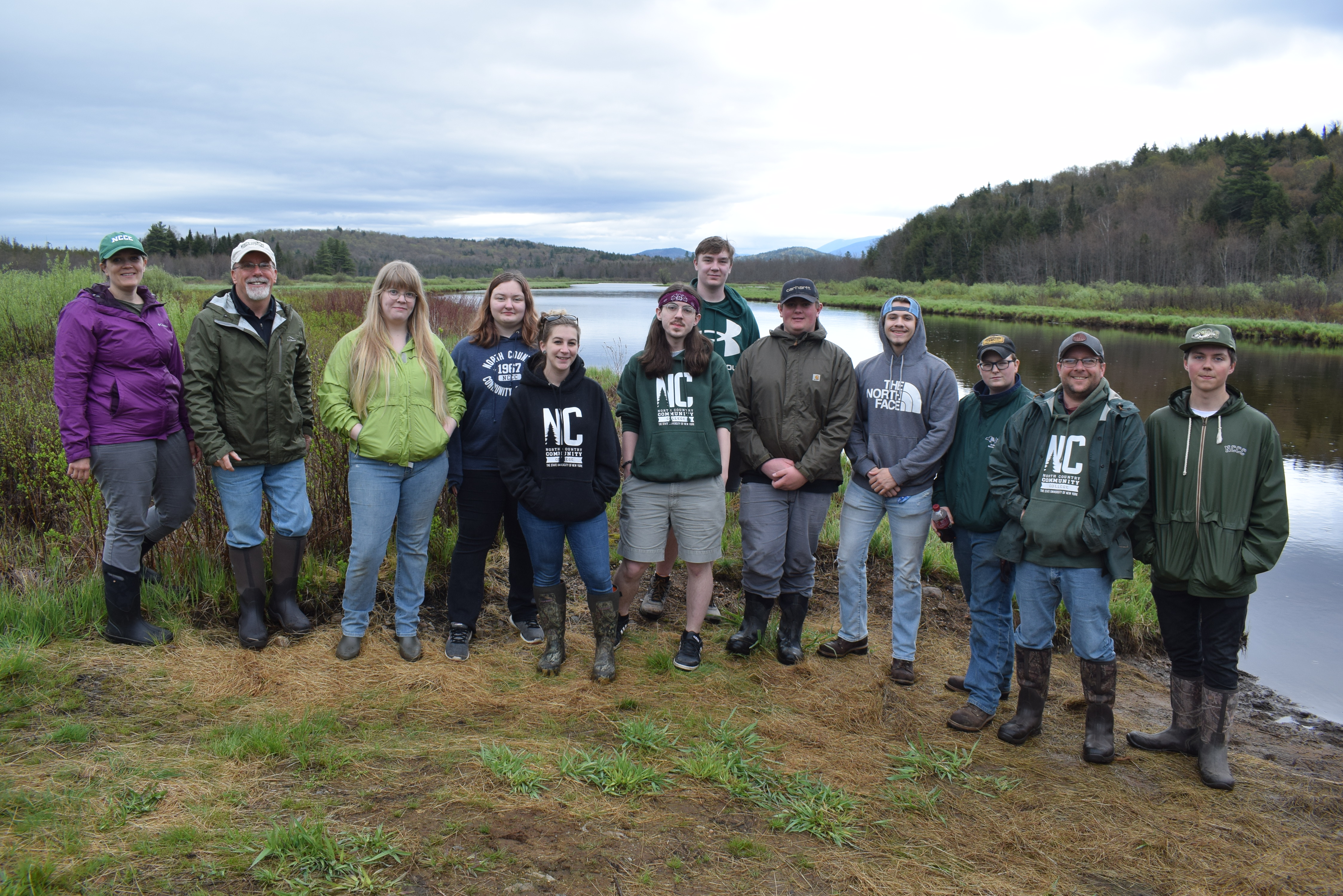
When the Adirondack Park was created in the 19th century, it was perhaps the most extensive conservation experiment ever undertaken. More than 100 years later, we’re still learning lessons from the waterways, forests and peaks within this 6-million-acre zone – and North Country students are among those doing the work. An Environmental Science class stands as a group along the Saranac River looking at the camera
As an Environmental Science major, you’ll learn the environment’s natural processes, as well as the interactions of plants, animals and other organisms with their physical and chemical environments. Our Saranac Lake campus gives you access to the rich ecosystems we’re part of – comprised of fields, forests, wetlands, and a pond that's for of a 40+ year study, so you will be able to visualize both short- and long-term changes. Our second-year courses of General Ecology and Conservation Biology both include labs that allow you to take what you've learned in the classroom and apply it out in the field, all while learning hands-on techniques for real-world data collection. 

CAREER POSSIBILITIES:  Conservation scientist, educator, environmental engineer, environmental science technician, wildlife biologist. Some career paths require additional education or training.

WHAT'S NEXT: Transfer for a bachelor’s degree in environmental science or enter the workforce. Students may also choose to benefit from the Gateway to Plattsburgh partnership with SUNY Plattsburgh.


Explore what our Environmental Science program is all about in this feature video


Check out some of our exciting courses...


Students working in the Field Methods class stand along a creek

General Ecology

BIO 225

Fall Semester

Students will learn ecological concepts, in a hands-on approach emphasizing the tools, techniques, and observational skills necessary for understanding both terrestrial and aquatic ecology. Students will conduct field and laboratory work as well as data analysis and interpretation in a student-led, teamwork, research-oriented comprehensive study of the campus.

A student looks at animal skulls at a lab table

Adirondack Biology

BIO 160

Fall Semester

A program favorite, this course is a survey of the natural history of the Adirondacks, looking at the ecology of the plant and animal communities of the region, and involves both classroom and outdoor activities, with a heavy emphasis on identification techniques of the local flora and fauna. 

Students doing outside lab work in the Conservation of Natural Resources class take measurements of a pine tree

Conservation Biology

BIO 204

Spring Semester

An exploration of the rich tapestry of life with which we share our world and how we can maintain it. Students examine conservation management history, with hands-on, real-world applications in both the classroom and the field. 


Shia Bright, an Environmental Science student from Macomb, NY, talks about her experience in the program and at the college.

Students work at a table in a science lab
A student looks at animal skulls at a science lab table
Students use a net in the Saranac River
Students stand outside a classroom building checking a birdfeeder
Students take measurements along a boardwalk in a bog
A student checks data on a clipboard at the back of a vehicle
Student sit on a boat in an Adirondack lake looking at a clipboard
Students inspect pans containing water and fish
A student looks at a piece of paper while sitting in the back of a boat on a lake